Projects
Foundational work
The modeling work of ALFRESCO and IEM has been central to much of SNAP's work since 2007, and has contributed to many separate projects and tools over the years.
-
ALFRESCO and Habitat Research
Boreal ALFRESCO (ALaska FRame-based EcoSystem COde) simulates the responses of subarctic and boreal vegetation to climatic changes. This work models spatial processes of fire and recruitment across the circumpolar arctic/boreal zone.
-
IEM: An Integrated Ecosystem Model for Alaska and Northwest Canada
Using modeling to understand potential landscape, habitat, and ecosystem change in Alaska and Northwest Canada.

Completed and ongoing projects
Please contact us if you're looking for specifics on other SNAP work.
-
Working with the US Department of Energy to research changes in sea-ice and marine ecosystems and the effects of those changes on coastal people, infrastructure, and economies.
-
How might survivable habitat for the spruce bark beetle change in forested regions of Alaska under future climate conditions? What areas are at risk for more damaging spruce beetle population levels?
-
This project enhanced Northern Climate Reports by including community- and borough-level demographic and health data, helping users understand who may be most impacted by these changes.
-
Alaska’s wildfire season can bring rapidly changing air quality, and Alaska residents need up-to-date information about wildfires and smoke to make informed decisions for themselves, their families, and their communities.
-
SNAP collaborated with the Alaska Department of Transportation to develop a point-precipitation frequency tool using climate projections to better understand the future of precipitation trends across Alaska.
-
This Adaptation Assessment was the first step in developing a climate adaptation plan for the Igiugig Village Council.
-
Assessing potential impacts of climate change on temperature, precipitation, water availability, vegetation, and fire regime in the National Petroleum Reserve-Alaska.
-
Facilitating community driven responses to self-reliance and sustainability challenges by identifying and linking relevant information and research support.
-
Climate change is affecting DoD infrastructure necessary for military readiness and daily operations. Clear, well-supported, contextual information is needed on appropriate and applied use of climate information for non-experts.
-
Unmanned aerial vehicle research resulted in the first bridge inspection and a hyper-detailed 3D model for bridge inspections in the United States.
-
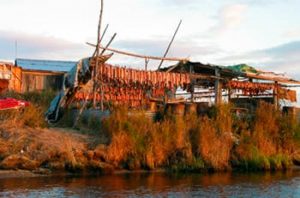
Working with Alaska rural communities to identify relationships between climate change and subsistence resource availability, and to use those relationships to project future resource availability.
-
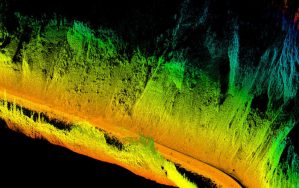
Highly detailed surface modeling and change detection methods have been developed to understand slope stability along critical Alaska highways at Glitter Gulch and Long Lake.
-
UAS research confirmed that threatened Steller Sea Lion populations could be more accurately and safely surveyed at their haul-outs and rookeries.
-
Understanding the connections among vegetation, the organic soil layer, and permafrost ground stability in Alaska boreal ecosystems.
-
Brief fact sheets providing climate projections for each of Alaska’s National Park Service areas.
-
This multi-year project enabled National Park Service (NPS) managers, cooperating personnel, and key stakeholders to develop plausible climate change scenarios for all NPS areas in Alaska.
-
SNAP and ACCAP contributed concise, objective, and engaging information about climate change, development and other Arctic issues.
-
Projections of shifts in 18 climate types linked to ecological biomes across Alaska, the Yukon, and the Northwest Territories. An expansion of the Connecting Alaska Landscapes project.
-
Developing a modeling tool for mapping future growing-season water availability for the Yukon.
-
An analysis of potential future climate change impacts in the Great Bear Lake region of the Northwest Territories, Canada.
-
A collaboration with UAF geophysicists to project what may happen to permafrost in the future, and to map these projections statewide.
-
Identifying conservation strategies and ecologically important corridors and/or barriers that impact connections between landscapes.
-
SNAP collaborated with scientists, engineers and foresters on an experimental burn that quantified the effects of fuels reduction treatments on fire behavior.