
Arctic Environmental and Engineering Data and Design Support System (Arctic-EDS)

Technical professionals working in the North need up-to-date engineering and environmental data that’s relevant, trustworthy and easy to obtain. Arctic-EDS is a system of online technologies that curates relevant Arctic environmental data in a central repository for use in engineering applications and computational notebooks.
About this tool
In the late 20th century, the need for accessible environmental information tailored to engineers and decision–makers, led to the publication of the Environmental Atlas of Alaska. The publication compiled maps of the best data available at the time. The Atlas provided a well–organized overview of the physical characteristics of the state alongside its waters, sunlight, and general climate. This was paired with engineering requirements and guidelines, as well as a thorough bibliography.
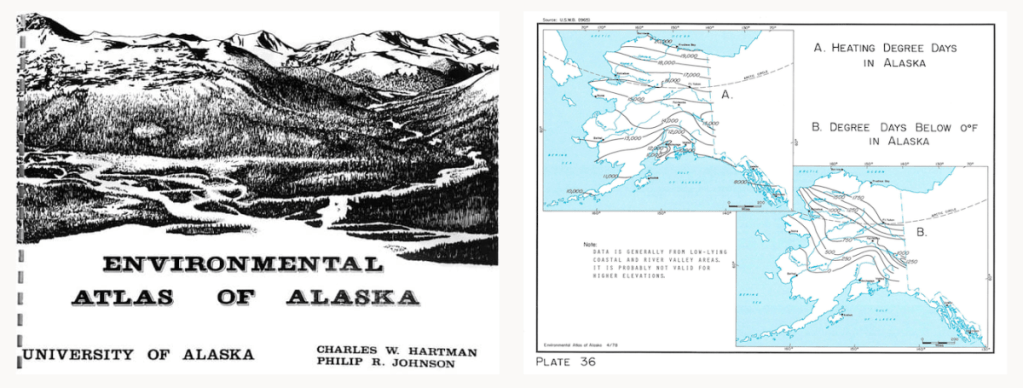
The Atlas ages
Over time the Atlas’ shortcomings became clear. Data gaps frustrated engineers and planners not working along the state’s road systems or rivers, and presented particular challenges to engineers in the far north and west. Complex topography, particularly in Southeast Alaska, also made coarse–scale maps imprecise. The data also assumed a steady climatic state while modern data tells a more detailed story—one of significant change.
A path forward
Alaska’s infrastructure must be robust to support the economic, defense, and social needs of a state experiencing a changing climate. Arctic-EDS was created to replace the aging Environmental Atlas of Alaska while addressing the old atlas’ shortcomings by providing finer scale data, filling data gaps, and incorporating climate projections. The Arctic-EDS provides easily obtainable, well–vetted, and reliable engineering and environmental data in a central website designed to meet the needs of engineering professionals.
Improved historical data allows this site to provide a more detailed picture of Alaska’s climate history. Modern climate science also allows the Arctic-EDS to make informed projections about the future of the state’s climate over the lifespan of Alaska’s infrastructure. Finally, the integration of functional modules, a data API, and Python notebooks allow for easy integration of Arctic-EDS data into modern engineering workflows relying on computer programs.
The Arctic-EDS team comprises experts from the University of Alaska Fairbanks’ International Arctic Research Center and Department of Civil, Geological, and Environmental Engineering; alongside experts from the University of Alaska Anchorage; the Cold Regions Research and Engineering Laboratory; Neptune, Inc.; and Lawrence Berkeley National Laboratory.
Thank you to our funders
Funding comes from the Environmental Security Technology Certification Program (ESTCP), an environmental technology demonstration and validation program of the United States Department of Defense. The team is grateful for ongoing support and feedback from the United States Army Corps of Engineers. Learn more about ESTCP
Project personnel
- T. Scott Rupp. Professor, International Arctic Research Center (IARC), UAF. Ecosystem modeler with climate downscaling expertise. Overall project management. Lead and supervise web-based technology refinement and deployment, data curation, and associated frameworks.
- Margaret Darrow. Professor of Geological Engineering, UAF. Expertise in frozen ground engineering and thermal modeling. Provide guidance on specialized module and notebook development. Integrate Arctic-EDS into classroom teaching of undergraduate and graduate engineering at UAF.
- Sveta Stuefer. Associate Professor of Civil and Environmental Engineering, UAF. Expertise in cold regions hydrology and hydraulics. Provide guidance and feedback on data, modules, and notebooks. Integrate Arctic-EDS into classroom teaching of undergraduate and graduate engineering at UAF.
- Kevin Bjella. Research Civil Engineer, Cold Regions Research and Engineering Laboratory. Geotechnical Arctic Engineer specializing in design and remediation of infrastructure in frozen environments. Focus on DoD user engagement module and notebook linkages to the UFC 3-130.
- Peter Larsen. Research Scientist/Deputy Group Leader, Lawrence Berkeley National Laboratory. Applied economist specializing in infrastructure depreciation under alternative climate/weather scenarios. Provide guidance on notebook development and incorporation of LCA.
- Aaron Dotson. Professor of Civil Engineering, University of Alaska Anchorage (UAA). Water and wastewater utilities expert. Coordinate linkage between the CRUM and development of functional design tools via notebooks and modules. Act as liaison to standing military POCs through the Applied Environmental Research Center.
- Paul Duffy. Vice President, Climate Change Program Leader, Neptune Inc.; Affiliate Faculty, UAF. Mathematical statistician with expertise in statistical methods used to downscale gridded climate data. Provide guidance and feedback on the development and implementation of statistical methods including Bayesian hierarchical modeling and simulation work.

Project Details
Contact: SNAP Data Team
Project Status: Ongoing
Collaborator(s):
- Lawrence Berkeley National Laboratory
- Neptune Inc
- U.S. Department of Defense Environmental Security Technology Certification Program (ESTCP)
- UAF International Arctic Research Center
- University of Alaska Anchorage
- University of Alaska Fairbanks
- USACE Cold Regions Research and Engineering Laboratory
Related Document(s):